Small Business SEO
How Small Businesses Get Found by AI: The 2026 Guide to Generative Engine Optimization
July 25, 2026
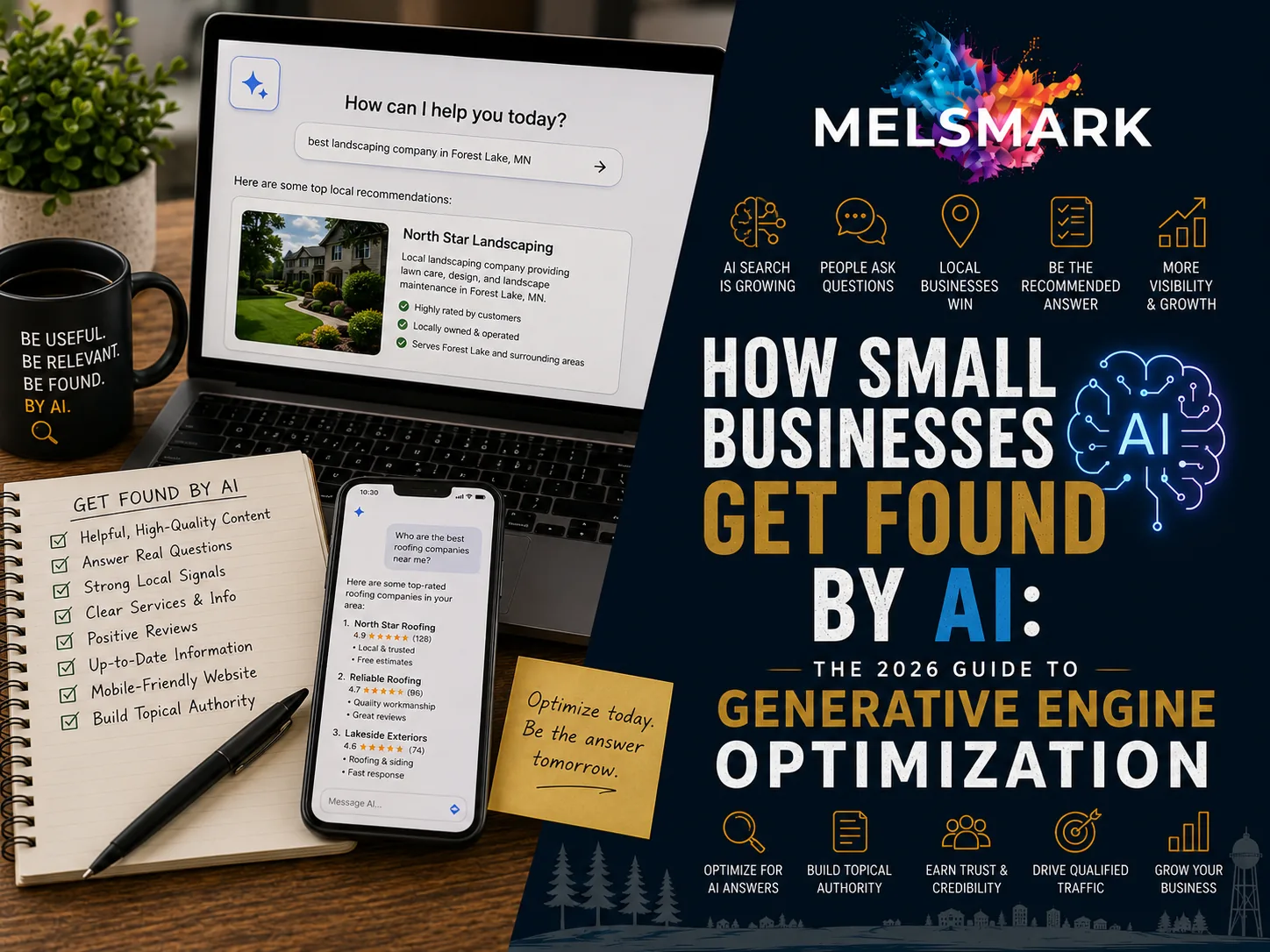
Generative engine optimization is the work of making your business the one an AI names when someone asks it for a recommendation. Not ranked in a list of ten. Named, out loud, in an answer that usually mentions two or three businesses total. It matters now because 45% of consumers used an AI tool to find a local business in the past year, up from 6% the year before, according to BrightLocal's 2026 Local Consumer Review Survey.
That is a seven-fold jump in twelve months. It made AI the third most-used channel for finding a local business, behind only Google and Facebook, and ahead of Yelp and Tripadvisor.
I want to be careful here, because this topic attracts more hype than almost anything else in marketing right now. So this guide sticks to what is actually documented, names the sources, and tells you plainly where the evidence runs out. If you want the short version: most of what works is work you already understand. The part that is genuinely new is smaller than the people selling GEO services would like you to believe, but it is real, and it favors businesses like yours more than you might expect.
What Changed, Exactly
For twenty years, being found online meant ranking. Somebody typed a few words, Google returned ten links, and your job was to be one of them. If you were fourth instead of first you still got some clicks. There was room on the page.
An AI answer has no room. Someone asks ChatGPT for a well drilling company near Forest Lake and gets two or three names in a sentence or two. There is no fourth place. You are either in the answer or you do not exist in that conversation, and you will never know it happened. No ranking drop, no alert, no notification. A prospect asked, got three names, called one of them. You were not one of them.
That is the actual shift. Search used to be a list you competed to appear on. Increasingly it is a recommendation you compete to be.
How Hard Is It to Get Recommended by AI?
Harder than ranking on Google, and it is worth knowing the real numbers.
SOCi's 2026 Local Visibility Index analyzed more than 350,000 business locations across 2,751 brands. ChatGPT recommended 1.2% of those locations. Gemini recommended 11%. Perplexity recommended 7.4%. The same businesses appeared in Google's local three-pack 35.9% of the time. SOCi's own summary puts AI local visibility at three to thirty times harder to achieve than traditional local search visibility.
Now the important caveat, because that 1.2% number gets thrown around without it. That study looked at multi-location brands, the kind with dozens or hundreds of storefronts. SOCi's own research notes that AI systems often favor independent, single-location businesses, because their hours, address, and business details tend to be far more consistent across the web. A chain with 200 locations has 200 chances to have mismatched information. You have one.
So read that statistic as a description of how selective AI recommendations are, not as your personal odds. If you are a one-location business in Anoka County with clean, consistent information and real reviews, you are competing on ground that suits you.
The other finding from that study matters just as much: in retail, only 45% of the brands leading in traditional local search also showed up among the most recommended in AI results. More than half of the businesses winning on Google were absent from AI answers. Ranking well and getting recommended are two different accomplishments now, and you have to earn them separately.
The Six Signals AI Uses to Pick a Local Business
Across the available research and platform statements, six things determine whether an AI system will name your business. I have ordered them by how much they actually move, based on what is documented rather than what sounds good.
-
Consistency of your basic facts. Your name, address, phone number, hours, and service area, identical everywhere they appear. This is the least glamorous item on the list and the most decisive. SOCi found business profile information was only about 68% accurate on ChatGPT and Perplexity, compared with 100% on Gemini, which is grounded directly in Google Maps data. When an AI encounters four versions of your phone number, it loses confidence in all four.
-
Third-party corroboration. Reviews, directory listings, mentions on other websites. An AI cannot verify anything you say about yourself. It can only check whether other sources agree with you. This is why a business that exists only on its own website is nearly invisible to these systems.
-
Review volume, rating, and recency. All three, not just the first. BrightLocal's 2026 data found 74% of consumers look for reviews written in the last three months, and 31% will skip a business rated below 4.5 stars. AI systems weight recency for the same reason people do: fresher data is more likely to still be true.
-
Content that answers real questions. This is the one you control most directly, and it is the one with the strongest research behind it. More on that below.
-
Whether a machine can actually read your site. If your content only appears after JavaScript runs, some AI crawlers will not see it. If your site blocks the crawlers outright, you are removed from consideration entirely. This is a technical detail that quietly disqualifies a lot of otherwise good businesses.
-
Being specific enough to be worth quoting. Generic content gets absorbed into a generic answer with no attribution. Specific claims, real numbers, and details nobody else has are what give an AI something to cite you for.
What the Research Actually Found
The founding study on this is worth knowing about, because almost everything written on GEO is downstream of it and most of it gets misquoted.
In 2024, researchers from Princeton, Georgia Tech, IIT Delhi, and the Allen Institute for AI published "GEO: Generative Engine Optimization" at KDD 2024, one of the main academic conferences in data science. They built a benchmark of 10,000 queries and tested nine different content strategies to see which ones increased the odds of a source being cited in an AI-generated answer.
Five strategies produced meaningful gains, up to roughly 40% improvement in visibility. The winners were:
- Adding statistics. Replacing "many businesses struggle with this" with a specific, sourced number.
- Citing sources. Attributing claims to a named study or authority.
- Adding quotations. Including relevant quotes from credible sources.
- Fluency optimization. Clear, well-constructed prose. Notable because this adds no new information at all. Clearer writing is simply easier for a model to parse and attribute.
- Authoritative voice. Writing with confidence rather than hedging.
And the strategy that performed poorly? Keyword stuffing. The oldest trick in SEO actively works against you in AI answers.
Notice what is on that list. Be specific. Use real numbers. Say where they came from. Write clearly. Do not hedge. That is not a new discipline. That is good writing, and it happens to be exactly what a machine trained on language finds easiest to extract and attribute.
One thing the study did not test, despite being cited constantly in arguments about it: schema markup. Structured data was never part of the experiment. That is worth knowing, because the claim that schema gets you cited by AI is repeated everywhere and the evidence behind it is far thinner than the confidence suggests. I've written a separate post on what the schema evidence actually says, because that conversation is full of confident claims that don't hold up.
What About Google's AI Overviews?
This is where most small business owners feel the change first, and where the picture is more encouraging than the headlines suggest.
AI Overviews now appear on roughly 48% of tracked queries, according to BrightEdge, up from about 31% a year earlier. When one appears, clicks drop sharply. Ahrefs measured a 58% decline in click-through rate for the top-ranking page across 300,000 keywords. Pew Research, tracking nearly 69,000 real searches from a panel of about 900 adults, found clicks fell from 15% of visits to 8% when an AI summary was present.
But the impact is not spread evenly, and the uneven part is good news for local businesses. Ahrefs found local searches trigger AI Overviews only about 7.9% of the time. When someone searches "plumber near me" or "roofer in Anoka," Google usually shows the map pack, not an AI summary. Your hire-me queries are relatively sheltered.
Where local businesses are fully exposed is informational and cost content. Whitespark data reported by Search Engine Journal found that informational near-me queries trigger AI Overviews around 92% of the time, and hybrid queries like "average cost of dental implants in Phoenix" hit 97%.
The short version: your service and location pages are relatively safe. Your blog posts, cost guides, and comparison pages are not. If your traffic has slipped this year, that split is usually where it happened. I've written before about the ways Minnesota small businesses miss online customers, and this is now near the top of that list. I wrote a full breakdown of what AI Overviews mean for a small business, including which of your pages are at risk and which are not.
The Pricing Opportunity Nobody Is Taking
Here is the part I find genuinely interesting, and it lines up with something I already believed before any of this AI business started.
Cost and price queries trigger AI Overviews more than 80% of the time. And most local businesses flatly refuse to answer them. Ask the internet what a new roof costs in Minnesota and you will get a dozen pages that dance around it, promise a free consultation, and never say a number.
So the AI finds the one source that did answer, and cites that one.
You do not have to publish a fixed rate. Give a real range and explain what moves it. "Most small business websites in Minnesota run between $1,200 and $3,200 as a one-time design fee, depending on page count, whether you need copywriting, and whether photography is included." That is a factual, organized answer. It gives an AI something to quote, and it gives a human being the respect of a straight answer.
I publish my starting prices on my web design page and I have written about what a small business website actually costs in Minnesota. I did that because I think hiding prices treats people badly. That it also happens to be the single most citable kind of content is a nice accident.
What to Do First, Second, and Third
First: make your facts consistent and your profile complete. Google Business Profile claimed, verified, and filled in completely. Same name, address, phone, and hours everywhere they appear. If you do nothing else on this list, do this. It is free, it takes an afternoon, and it is the foundation everything else sits on. My Google Business Profile guide walks through it, and Gemini is grounded directly in Google Maps, so your profile is literally the source for one of the three major AI platforms.
Second: build a steady review habit. Not a push. A habit. Ask after every good job, make it one tap, and keep doing it forever. Recency is a signal now, so twenty great reviews from 2023 lose to eighty with a steady trickle from this quarter. BrightLocal's 2026 survey found 74% of consumers look for reviews written in the last three months, and AI systems apply similar logic for the same reason: I go deeper on why reviews and citations decide whether AI reccomends you
Third: answer the questions your customers actually ask. Especially the cost ones. Especially the ones your competitors avoid. Write them clearly, put a real number in, and say where the number came from.
Everything after that is refinement. Server-side rendering so crawlers can read your pages. Not blocking AI crawlers in your robots file. Getting listed in the directories that matter. Useful, but secondary to the three above.
What Nobody Knows Yet
I would rather tell you this than pretend otherwise.
We do not know exactly how these systems weight their inputs. The companies have not published their retrieval logic, and it changes. We know ChatGPT Search launched using Bing's index and supplements it with OpenAI's own crawler, and Botify's analysis of seven billion log files through March 2026 suggests OpenAI has been building out its own index substantially. But the precise mix is not public.
We do not have peer-reviewed research on most of the tactics being sold as GEO services. The Princeton study is real and rigorous. Much of what has been built on top of it is vendor marketing with a citation stapled on.
And here is the finding that should keep everyone honest: BrightLocal found that of the consumers already using AI for local searches, only 18% felt ready to contact the business the AI recommended. The rest kept researching, verifying on Google, checking the website. Eighty-eight percent said they fact-check reviews an AI cites.
An AI recommendation is the start of the journey, not the end of it. Which means the thing that closes the deal is still the same thing it has always been: a website that tells the truth about how good your work is, and holds up when someone checks.
The Bottom Line
Generative engine optimization is mostly the fundamentals, done properly and consistently, plus a genuine shift in how you write. Be specific. Use real numbers. Say where they came from. Answer the questions everyone else dodges, including the price one. Keep your facts identical everywhere. Keep the reviews coming.
The businesses that will win the AI answer in your town are not the ones with the biggest marketing budget. They are the ones with the cleanest information, the freshest reviews, and content that actually says something. That has always been a fair fight, and for once the technology is tilting it toward the small operator instead of away.
If you want to know where you stand right now, my free Local SEO Checklist walks through the fundamentals, and the ten-minute test in the last question below will tell you whether AI currently knows you exist.
Frequently Asked Questions
What is generative engine optimization?
Generative engine optimization, or GEO, is the practice of making your business likely to be named and cited inside AI-generated answers on tools like ChatGPT, Google AI Overviews, Gemini, and Perplexity. Traditional SEO competes for a spot in a list of links. GEO competes to be one of the two or three businesses an AI actually recommends.
Is GEO different from SEO?
Mostly it overlaps. The fundamentals are the same: accurate information, real reviews, clear content, a site machines can read. What is genuinely different is the emphasis on being specific and quotable rather than broadly relevant, and the fact that there is no second page to fall back on. Anyone selling GEO as a completely separate expensive service is repackaging most of what SEO already covered.
Do I need to hire someone to do GEO?
Not for the first three steps. Claiming your Google Business Profile, keeping your business details consistent, and asking for reviews are all things you can do yourself in a weekend. Where help pays off is in building content that answers real questions well and making sure your website is technically readable by AI crawlers.
How long does it take to show up in AI answers?
There is no reliable published figure, and anyone quoting one precisely is guessing. Practically, profile and review improvements can register within weeks. Content-driven visibility tends to take longer, in the range of a few months, because the systems have to crawl, index, and build confidence in you as a source.
How do I know if AI is recommending my business right now?
Ask it. Open ChatGPT, Gemini, and Perplexity, and type the question a customer would type: your service plus your town. Write down whether you appear and who does instead. Do it again in a month. That is the only reliable measurement available today, and it costs you ten minutes.
Not sure where your business stands in AI search?
I'm a web designer in East Bethel, MN. I build websites for Minnesota small businesses that are made to be found, by people and by the systems people now ask for recommendations. Happy to run a few searches with you and tell you honestly what I see.
Get in touch or start with the free Local SEO Checklist.