Small Business SEO
Google AI Overviews Are Taking Your Clicks. Here Is What to Do About It.
July 29, 2026
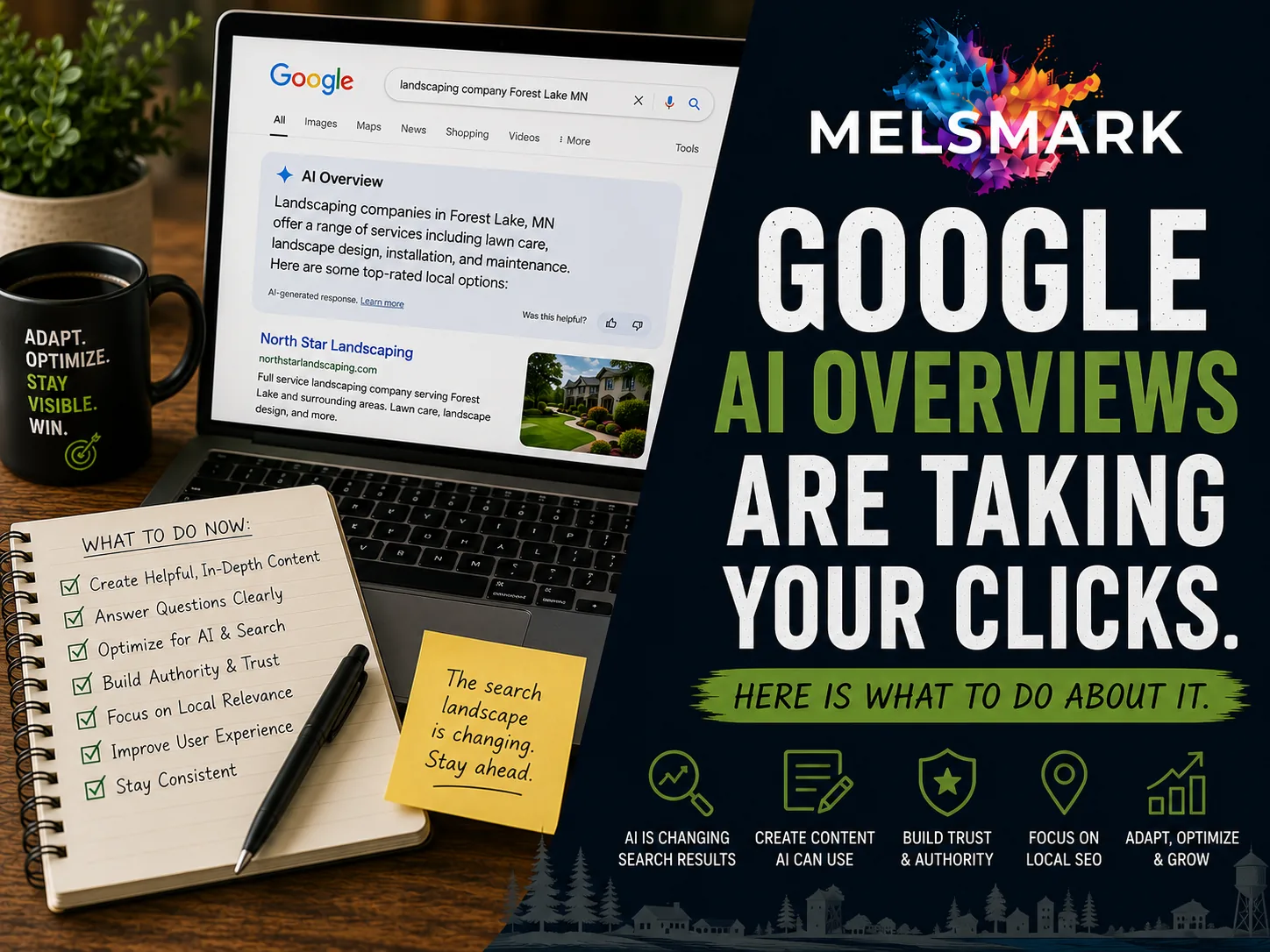
An AI Overview is the block of AI-written text Google now puts above the search results, answering the question before anyone scrolls. They appear on roughly 48% of tracked queries as of early 2026, according to BrightEdge, up from about 31% a year earlier. When one appears, clicks to websites drop significantly.
If you have watched your website traffic slide over the past year without a clear explanation, this is probably a large part of it.
But the impact is not evenly spread, and the way it lands on a local service business is different from how it lands on a recipe blog. Some of your pages are genuinely exposed. Others are barely affected at all. Knowing which is which is the difference between a useful response and a panic.
How Much Traffic Are We Actually Talking About?
Three credible studies, different methods, same direction.
Ahrefs analyzed 300,000 keywords using Search Console data and found a 58% drop in click-through rate for the top-ranking page when an AI Overview appears. That is up from a 34.5% drop measured eight months earlier.
Pew Research Center ran the most careful version of this, tracking nearly 69,000 real searches from a panel of about 900 adults. When an AI summary was present, users clicked an organic result on 8% of visits. Without one, 15%. Roughly half.
Seer Interactive, tracking billions of impressions, found click-through rate on AI Overview queries bottomed out at 1.3% in December 2025 and then recovered to 2.4% by February 2026. So the trend is not a straight line down, which is worth knowing before anyone tells you the sky is falling permanently.
That is the honest picture. Real, significant, not apocalyptic, and still moving.
Which of Your Pages Are Actually at Risk
This is the part that matters, and almost nobody covers it properly.
AI Overviews trigger based on the type of question being asked, not simply on whether the search is local. Here is roughly where they show up:
| Query type | Example | AI Overview trigger rate |
|---|---|---|
| Hybrid cost and local | "average cost of a new roof in Minneapolis" | ~97% |
| Comparison, X vs Y | "metal roof vs asphalt shingles" | ~95% |
| Informational near-me | "how long does a well inspection take near me" | ~92% |
| Review-related | "best roofing companies reviews" | ~86% |
| Question format | "how do I know if I need a new well pump" | ~86% |
| Simple local transactional | "roofer near me" | ~5 to 15% |
Read that table twice. The pattern is unmistakable. The moment your content is educational rather than transactional, you are in AI Overview territory. Every blog post you have written explaining your service, every cost guide, every comparison, every "what to expect" page. That is where the clicks went.
That last row deserves a note, because published estimates vary and you will see conflicting numbers. Ahrefs put AI Overviews on local searches at about 7.9%. BrightLocal measured 4 to 8% for "near me" and "[city] + [service]" queries. Whitespark found closer to 15% for pure local intent. They disagree because they define "local search" differently, but all three agree on the shape: when someone searches "roofer in Anoka" or "well drilling near Forest Lake," Google usually serves the local map pack, not an AI summary.
One number you may see quoted against this: Whitespark also reports AI Overviews on 68% of local searches overall. That is not a contradiction, it is an average being pulled up by the top of the table. Whitespark's "local searches" bucket includes informational and cost queries that happen to mention a place, and those trigger at 92 to 97%. Split by intent and the picture holds: the questions people ask while learning are exposed, the searches people run while hiring are not.
Your hire-me pages are relatively sheltered. That is genuinely good news and it applies to most of what a local service business depends on.
The Counterintuitive Part
Here is the finding that changes how you should respond.
Seer Interactive found that pages cited inside an AI Overview get more clicks than pages on that same results page that are not cited. Being in the AI answer is better than being below it.
Worth being precise about the size of the prize: cited pages earn substantially more clicks per impression than uncited ones on the same page, but they still trail what pages earn on results with no AI Overview at all. Citation is the best available outcome on an AI Overview page, not a restoration of the old numbers.
Still, the goal shifted. It is no longer "rank first and collect the click." It is "be the source the summary quotes, and collect the click from people who want more than the summary gave them."
That reframes the whole problem. An AI Overview is not purely a thief. It is a new placement, and it is one you can compete for.
The Cost Question Everyone Is Dodging
Price and cost queries trigger AI Overviews more than 80% of the time. And most local businesses will not answer them.
Search for what a new furnace costs in Minnesota. You will get page after page that promises a free estimate, explains that every home is different, and never gives you a number. So Google's AI finds the one page that did give a number, and cites that one.
That page gets the citation, the visibility, and the phone call.
I understand the reluctance. Publishing prices feels like arming your competitors and locking yourself into a figure. But you do not have to publish a fixed rate. Publish a range and explain what moves it.
"Small business websites in Minnesota typically run $1,200 to $3,200 as a one-time design fee. The range depends on how many pages you need, whether you need the copy written, and whether photography is included."
That is honest, useful, and quotable. It gives the AI a factual, organized answer it can confidently cite. It also treats the person asking with respect, which is why I published my own pricing and wrote a whole post on what a website actually costs in Minnesota long before any of this was a search strategy.
Your competitors are leaving that citation on the table out of habit. Take it.
What to Actually Do
Protect what is working. Your service pages and location pages sit in the query types AI Overviews rarely touch. Do not neglect them chasing AI visibility. That is where the calls come from.
Change how you write the informational stuff. The research on what gets cited is consistent: be specific, use real numbers, attribute them, write clearly, and do not hedge. The Princeton GEO study published at KDD 2024 tested nine content strategies and found adding statistics, citing sources, adding quotations, and writing fluently all produced meaningful gains, up to roughly 40%. Keyword stuffing made things worse.
Answer the cost questions. Ranges, with the variables explained. This is the single largest unclaimed opportunity for most local businesses.
Put the answer first. Lead every page with a direct answer in the opening two sentences, then explain. Both the AI and the human are looking for the same thing, and burying it helps neither.
Track differently. Impressions in Search Console are now a better health signal than clicks alone, because appearing in an AI Overview generates an impression without a click. Watch whether you are being seen, not only whether you are being clicked.
What Not to Do
Do not use the nosnippet tag to block Google from summarizing your content. It also removes you from featured snippets and reduces your visibility broadly. Publishers have tested it and the trade is generally not worth it.
Do not stop publishing. The instinct to give up on content because AI eats the clicks gets it exactly backwards. Content is how you become the cited source. Thin, generic content is what stopped working. Specific, genuinely useful content works better than it used to.
And do not buy a product that promises to get you into AI Overviews. Nobody can promise that. What actually works is boring, cheap, and within your control.
The Bottom Line
AI Overviews are real and they took a meaningful share of clicks, particularly on informational content. They barely touch the local, transactional queries most service businesses live on.
The response is not to fight the format. It is to be the business the format quotes. Answer the questions plainly, put real numbers in, say where they came from, and stop dodging the price question. That was good practice before any of this and it is now also the most reliable path into the answer box.
If you want to check how your own site reads to these systems, start with my free Local SEO Checklist, or read the full guide to getting found by AI.
Frequently Asked Questions
Do AI Overviews appear for local searches?
It depends on the kind of local search. For simple transactional ones, rarely: Ahrefs found about 7.9%, and searches like "plumber near me" usually return the map pack instead. But informational local queries, such as "how long does a septic inspection take," trigger them around 92% of the time, and local cost queries hit roughly 97%. Averaged across every query that mentions a place, the rate looks much higher, which is why published figures vary so widely.
Can I opt out of AI Overviews?
Not selectively. You can use the nosnippet meta tag to stop Google extracting text from your pages, but it also removes you from featured snippets and hurts your general visibility. Most publishers who have tested it concluded the trade-off is not worth it.
Is it better to be cited in an AI Overview or ranked first below it?
Cited. Seer Interactive found pages cited inside an AI Overview receive more clicks than uncited pages on the same results page. It is still fewer clicks than that page would earn on a result with no AI Overview, but citation has become its own placement worth competing for.
Why did my website traffic drop this year?
AI Overviews are a likely contributor if your traffic came mainly from informational blog content, cost guides, or comparison pages. If your traffic came from service and location pages targeting local transactional searches, the cause is more likely something else, and worth investigating separately before you rebuild a strategy around it.
Your website should still be earning its keep.
I build sites for Minnesota small businesses that are made to be found, whether the visitor arrives from a map pack, an AI answer, or a neighbor's recommendation.
Based in East Bethel, MN, serving Forest Lake, Anoka County, and the Twin Cities. Let's talk about your site, or start with the free Local SEO Checklist.