Small Business SEO
Schema Markup for Small Business Websites, Explained Without the Jargon
July 31, 2026
Schema markup is a block of code you add to your website that states your business facts in a format machines read directly, instead of making them guess from your page text. It tells a search engine "this is the business name, this is the phone number, this is the price, this is the author" in plain, labeled data.
It is worth adding. It is cheap, it powers real features in Google search, and it removes ambiguity about who you are.
It is also the single most oversold tactic in marketing right now, and I am going to show you the actual evidence rather than repeat the claim everyone else is making. If you came here looking for permission to skip it, you will not get that. If you came here having been told that schema is the key to getting cited by ChatGPT, you should know that the research does not support that.
What It Actually Is
Imagine handing someone your business card versus having them figure out your details from a paragraph you wrote about yourself.
The paragraph works. A person reads it and understands. But they have to interpret. Is "Melsmark" the business name or a product? Is that number a phone or an address? Is $1,200 the price or something else?
The business card removes the guessing. Name here. Phone here. Role here. Labeled, in a format that means the same thing every time.
Schema markup is the business card version of your web page. Your page still has the paragraph, for humans. The schema sits behind it in the code, telling machines exactly what each thing is.
It uses a shared vocabulary called Schema.org, which Google, Microsoft, Yahoo, and Yandex all agreed on back in 2011. There are more than 800 types in it. You need about five.
The Five Types a Small Business Actually Needs
-
LocalBusiness or Organization. Who you are. Name, address, phone, hours, service area, logo, and links to your social profiles. This is the foundation. Without it, a machine has to infer your identity from context, and inference is where errors come from.
-
Service. What you sell, and what it costs. If you publish a starting price, this is where you state it in a format that cannot be misread.
-
Article or BlogPosting. For every blog post. Who wrote it, when it was published, when it was last updated, what it is about.
-
Person. For whoever writes your content. Their name, their role, what they know about. This connects a real human being with real experience to the words on the page.
-
FAQPage. For the question and answer sections on your pages.
BreadcrumbList is a reasonable sixth if your site has any depth to it. Beyond that you are into diminishing returns for a small business.
A Real Example You Can Copy
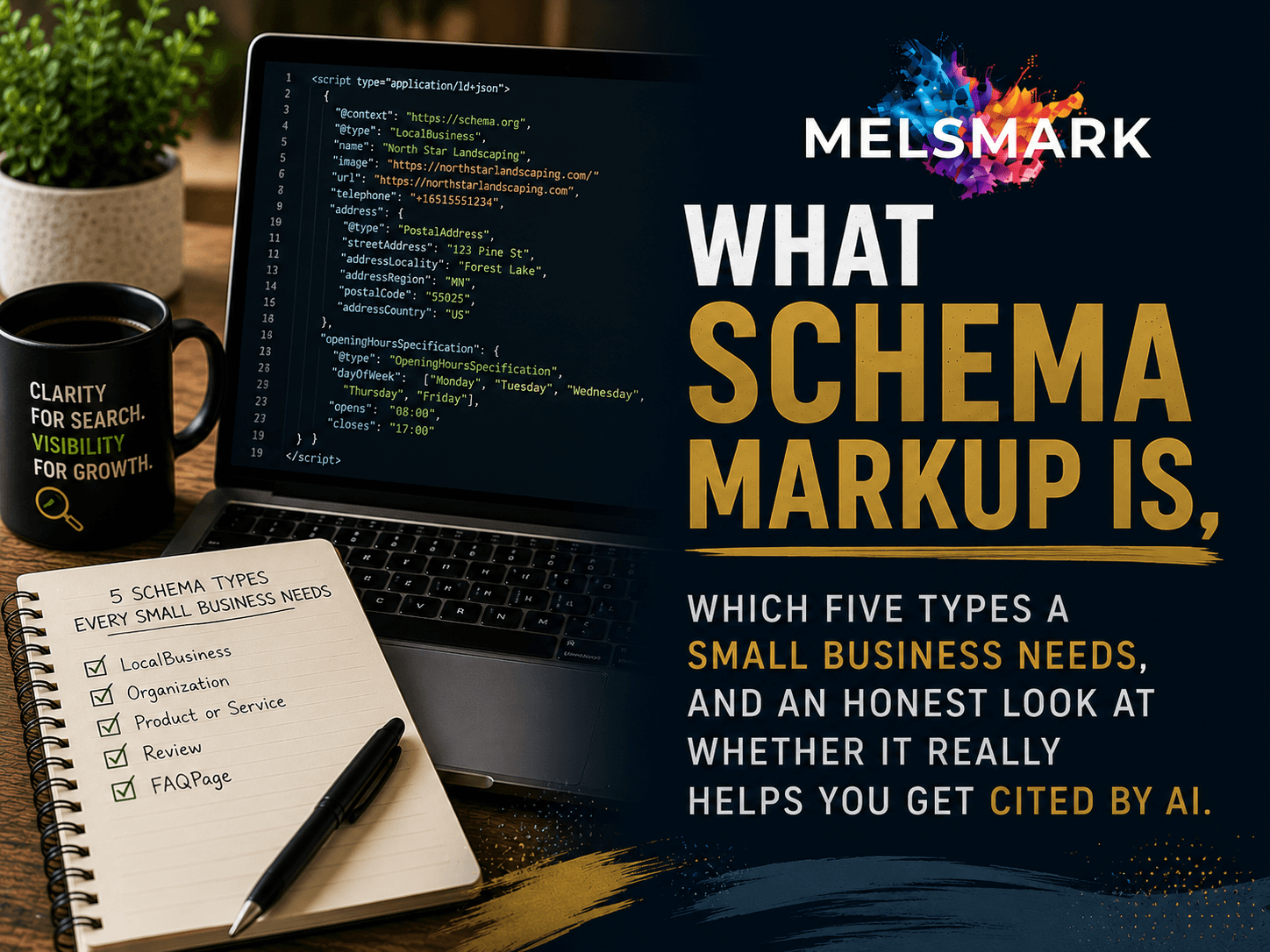
Here is a LocalBusiness block for a Minnesota business. Replace the values with yours and put it in the head of your page.
{
  "@context": "https://schema.org",
  "@type": "LocalBusiness",
  "name": "Your Business Name",
  "description": "What you do, in one clear sentence.",
  "url": "https://www.yourbusiness.com",
  "telephone": "+16125551234",
  "email": "you@yourbusiness.com",
  "address": {
    "@type": "PostalAddress",
    "streetAddress": "123 Main Street",
    "addressLocality": "Forest Lake",
    "addressRegion": "MN",
    "postalCode": "55025",
    "addressCountry": "US"
  },
  "areaServed": [
    { "@type": "City", "name": "Forest Lake" },
    { "@type": "City", "name": "East Bethel" },
    { "@type": "AdministrativeArea", "name": "Anoka County" }
  ],
  "openingHours": "Mo-Fr 08:00-17:00",
  "priceRange": "$$",
  "sameAs": [
    "https://www.facebook.com/yourbusiness",
    "https://www.instagram.com/yourbusiness"
  ]
}
Two rules that matter more than the code itself.
Everything in your schema must also be visible on the page. If you claim hours in the markup that do not appear anywhere a visitor can see, Google treats that as spammy structured data. The markup describes the page. It does not replace it.
Test it before you trust it. Google's Rich Results Test and the Schema.org validator are both free. Paste your URL, read the errors. A broken schema block does nothing at all, and plenty of sites have one without knowing.
Now the Honest Part: Does This Help With AI?
You have probably read that schema markup is essential for getting cited by ChatGPT and other AI tools. You have possibly read a specific number, like 36% more likely to be cited, or 2.5 times higher chance of appearing in AI answers.
Almost none of those numbers have a credible source behind them. Here is what is actually documented.
What has been confirmed by the platforms themselves. Microsoft's Fabrice Canel, a principal product manager for Bing, said at SMX Munich in March 2025 that schema markup helps Microsoft's language models understand web content for Copilot. Google's structured data engineer Ryan Levering said something similar at Search Central Live in New York days later. That is real, on the record, and worth taking seriously.
What Google says about its own AI features. Google's published guidance states that AI Overviews require no special schema, no llms.txt file, and no new markup, and names those things specifically. That is the company running the largest answer engine in the world telling you the tags are not the lever.
What the independent research found. A Search Atlas study compared schema coverage against citation rates across OpenAI, Gemini, and Perplexity and found no correlation. Domains with comprehensive schema did not outperform domains with minimal schema. An Ahrefs analysis in 2026 similarly found no measurable lift in citations from adding structured data.
What live testing showed, and this one is more interesting than the headline version. Mark Williams-Cook ran a test published in Search Engine Journal in 2026 that gets quoted as proof schema does nothing. What he actually did was hide an address inside a block of deliberately invalid, made-up JSON-LD, using a fake context and a fake type, with the address appearing nowhere in the visible text of the page. ChatGPT and Perplexity both returned it.
So these systems are not ignoring your schema. They are reading it as ordinary text, tokenizing the words inside the code block like any other words on the page, rather than parsing it as structured data the way a search engine does. The practical implication is the same either way: the labeled structure buys you nothing extra with a language model, even though the words inside it are visible to one.
What the founding academic study tested. The Princeton and Georgia Tech GEO paper from KDD 2024 gets cited constantly in schema arguments. It did not test schema. It tested in-content strategies: adding statistics, citing sources, adding quotations, writing clearly. Those worked, up to about 40% improvement. Schema was never part of the experiment.
What we have zero of. Peer-reviewed research on schema's effect on AI search visibility. As of 2026, none exists.
There is one piece of evidence pointing the other way that deserves a mention. SE Ranking's data found roughly 71% of pages cited by ChatGPT contain structured data. That sounds compelling until you consider that well-run, well-resourced websites tend to have both schema and the qualities that actually earn citations. SE Ranking says as much themselves. Correlation, not causation.
So What Should You Conclude?
Add the schema. Do not expect it to be the thing that gets you named by an AI.
Here is the reasoning. It is cheap, usually a one-time setup. It genuinely powers rich results in traditional Google search, which still drives most of your traffic. Two major platforms have said on the record it helps their systems understand content. And it costs you nothing but a couple of hours.
But if someone is selling you a schema package as an AI visibility solution, they are selling you a plumbing upgrade and calling it a new kitchen. The evidence for the AI claim is a pair of platform statements, two null-result studies, one test showing the markup is read as plain text, zero peer-reviewed research, and a great deal of vendor marketing.
What the research does support, consistently, is content. Be specific. Use real numbers. Say where they came from. Write clearly. Answer the actual question. That is what moved the needle in the only rigorous study anyone has run, and it is what I would spend your time on first.
I have written more on what actually gets a small business found by AI, including the six signals that appear to matter most.
About FAQ Schema Specifically
Worth a note, because this one changed.
FAQPage schema used to earn you an expandable FAQ display in Google's search results, which took up more space and pulled more clicks. In 2023 Google restricted that display to government and health sites. For everyone else, it is gone.
The markup is still reasonable to keep if your page has genuine question and answer content, because it makes those pairs cleanly extractable. What stopped making sense is bolting an FAQ section onto a page purely to grab more room in the search results. That use case is over.
What This Looks Like in Practice
Every website I build ships with LocalBusiness, Service, Article, Person, and FAQPage schema configured correctly and validated. Not because I think it is magic, but because it is part of building something properly, the same way I would not leave the wiring half finished because the lights technically turn on.
You should never have to think about it, and you should not have to pay extra for it. It is a couple of hours of setup that removes ambiguity about who you are, and ambiguity is the thing that quietly costs small businesses visibility.
Frequently Asked Questions
Does schema markup help me get cited by ChatGPT?
The evidence is genuinely mixed. Microsoft has confirmed schema helps its models understand content for Copilot, but independent studies from Search Atlas and Ahrefs found no correlation between schema coverage and AI citation rates, and Google says its AI features need no special markup. Add schema because it helps traditional search and costs little, not because it will get you named by an AI.
Will schema markup improve my Google rankings?
Not directly. Schema is not a ranking factor. What it does is make you eligible for rich results, which can meaningfully improve how your listing looks and how many people click it. Better click-through can improve your position over time, but the markup itself does not move you up.
Can I add schema markup myself?
If your site runs on WordPress or a similar platform, plugins can generate most of it with no code. On a custom site you or your developer add a JSON-LD block to the page head. Either way, validate it with Google's Rich Results Test afterward, because broken schema does nothing and is common.
What happens if my schema is wrong?
Usually nothing, and that is the problem. It simply gets ignored, so you get no benefit while assuming you have one. The exception is claiming things in markup that do not appear on the page, which Google treats as spammy structured data and can act on.
Wondering what is actually under the hood of your website?
I'm a web designer in East Bethel, MN, with about ten years in technical support before I ever built a site for anyone. Schema, structured data, and the parts nobody sees are included in every build, not sold as an upgrade.
Get in touch, or request a free website audit if you want an honest look at what your site is and is not doing.