Small Business SEO
Why Reviews and Citations Decide Whether AI Recommends You
August 2, 2026
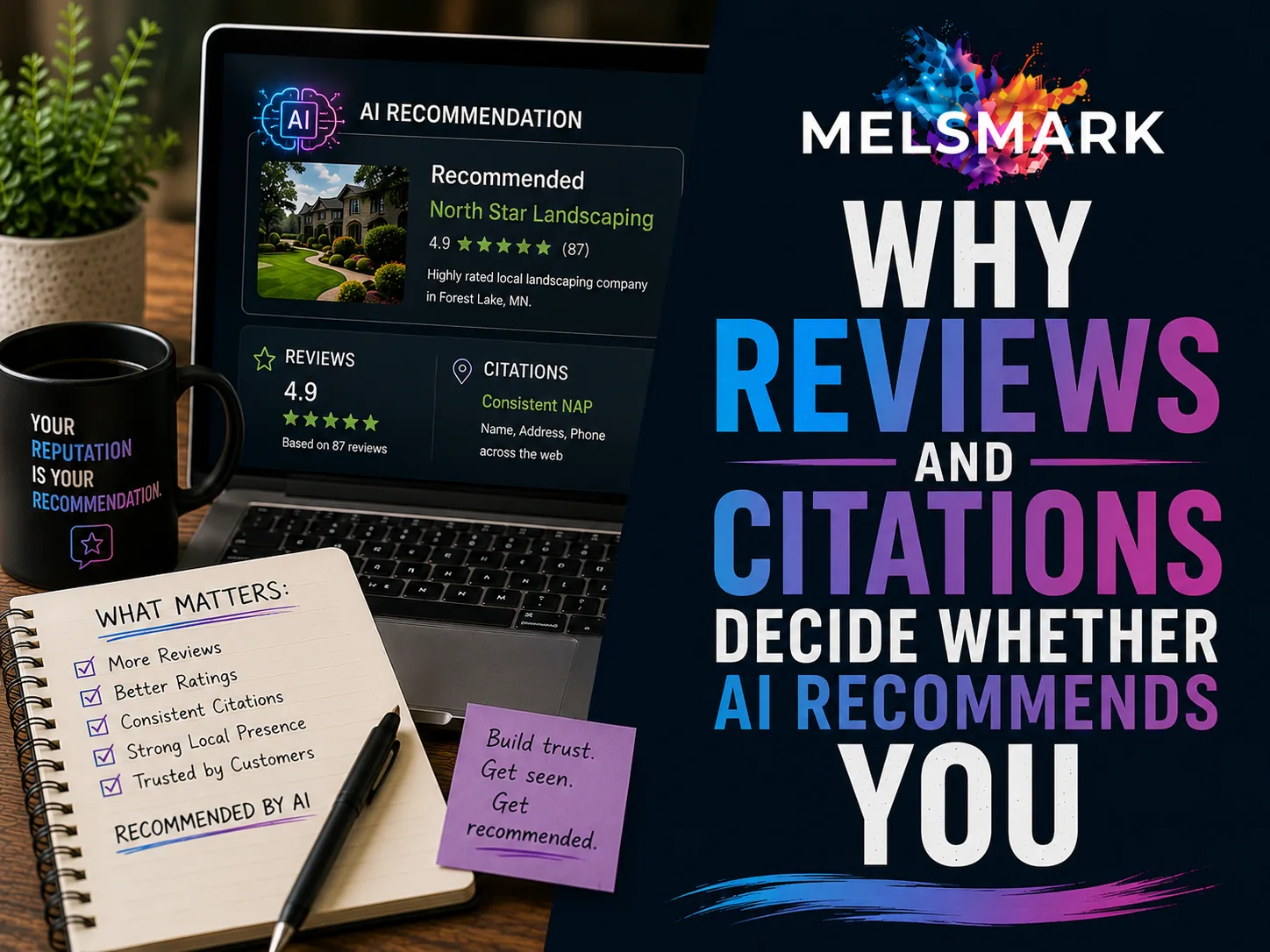
An AI system has no way to check whether you are good at your job. It cannot inspect your work, call your references, or drive past a house you built. So it does the only thing available: it checks whether independent sources agree about you, and it treats agreement as confidence.
That is the whole mechanism. Everything else in this post follows from it.
The practical version: reviews and consistent listings across the web are not "also important" alongside your website. For AI recommendations specifically, they are the primary evidence. Your website is what you say about yourself, which is exactly the testimony a careful system discounts.
If that sounds like bad news, it is not. It is the most encouraging thing about this whole shift, and I will explain why toward the end. This is one of the six signals I covered in the full guide to getting found by AI, and it is the one I would fix first.
The Corroboration Problem
Imagine someone asks you to recommend a well drilling company in Forest Lake and you know nothing about the industry. You would not read the companies' own websites and pick the one with the best adjectives. Every one of them says they are experienced, reliable, and family owned.
You would ask around. You would look for people who had actually hired them.
That is exactly what these systems do, and for the same reason. Self-description is not evidence. Independent agreement is.
This is why a business that exists only on its own website is close to invisible to AI recommendation. There is one source, and it is you.
What the Data Says About Reviews
BrightLocal's 2026 Local Consumer Review Survey, published in February and based on 1,002 US adults, found several things that matter here.
Ninety-seven percent of consumers read reviews when evaluating a local business, and 41% now say they "always" read them, up from 29% the year before. Thirty-one percent will not consider a business rated below 4.5 stars.
But the finding that changed my own advice is this one: 74% of consumers look for reviews written in the last three months.
Recency, not just volume. That reframes the whole thing. A business with twenty excellent reviews from three years ago is, in the eyes of both a customer and a machine, a business with no current evidence. The reviews describe a company that existed in 2023. Whether it still operates that way is unknown.
Eighty reviews built up with a steady trickle, including some from this quarter, tells a different story, and it is the story that gets you recommended.
There is a related finding worth sitting with. BrightLocal found that generic or templated review responses put off 50% of consumers, who read them as a sign of indifferent service. Responding matters. Responding with a form letter is worse than most people assume.
Why Your Google Business Profile Is the Load-Bearing Wall
Here is a detail that surprised me and changes where I would put effort first.
SOCi's 2026 Local Visibility Index found business profile information was accurate about 68% of the time on ChatGPT and Perplexity, and 100% of the time on Gemini. The reason is straightforward: Gemini is grounded directly in Google Maps data.
Your Google Business Profile is not one signal among many for that platform. It is the source. Whatever is in there is what Gemini knows.
It also propagates. Directories pull from it. Other sites cite it. Aggregators copy it. Fix the source and the copies improve over time. Leave an old phone number in there and you will be finding that old phone number in strange corners of the internet for years.
If you have not been through your profile field by field recently, that is the highest-value hour available to you. My Google Business Profile guide covers the setup in detail.
The Consistency Problem, Explained Properly
Every local SEO article tells you to keep your name, address, and phone consistent. Almost none of them explain why it actually matters, so the advice sounds like housekeeping and gets skipped.
Here is the mechanism.
A system encounters your business on six different websites. On four of them the phone number is 612-555-1234. On one it is an old number from when you switched carriers. On one the suite number is missing from the address.
A human glances at that and thinks, close enough, same company. A retrieval system does not have that intuition. It has six records with conflicting fields, and conflicting fields lower confidence. When confidence drops, it recommends the business it is more sure about instead.
You did not lose that recommendation because your work is worse. You lost it because you changed carriers in 2021 and never updated a directory you forgot existed.
This is the least glamorous work in marketing and it decides more outcomes than most of the glamorous work does.
The Ten Citation Sources Worth Your Time
Not all listings are equal. Most directory sites are junk that exist to sell you upgrades. These are the ones I would actually spend time on for a Minnesota small business, roughly in order.
-
Google Business Profile. Non-negotiable, and the source everything else copies.
-
Bing Places. Ten minutes, and it puts a verified record in the index ChatGPT has drawn from.
-
Apple Business Connect. Free, and Apple Maps usage nearly doubled in BrightLocal's recent data.
-
Facebook Business Page. Still the second most-used channel for local business discovery.
-
Your local chamber of commerce. Paid, but it is a genuinely trusted regional domain and a real community relationship.
-
Yelp. Even if you dislike it. It is heavily indexed and frequently pulled into AI answers.
-
Better Business Bureau. Carries disproportionate weight as a trust signal.
-
Your industry's directory. Houzz for builders and remodelers, Angi for home services, the trade association in your field. One good vertical listing beats ten generic ones.
-
Nextdoor Business. Small reach, unusually high local trust.
-
Supplier and partner pages. If a manufacturer or supplier lists authorized dealers, get on it. These are some of the strongest links most local businesses can get and they are usually free.
Anything beyond this list is optional. Bulk directory submission services are worse than useless, because they often introduce the inconsistencies described above.
A Review System You Will Actually Run
Every article about reviews recommends a process nobody executes. Here is the version that survives a busy week.
Pick the moment. One specific point in your job where the customer is happiest. Right after the walkthrough. When you hand over the keys. When the site goes live. Same moment every time so it becomes automatic.
Make it one tap. Get your direct Google review link, shorten it, and save it in your phone as a text you can paste. If the customer has to search for you, most will not.
Say it like a person. "It really helps my business when people leave a review. Would you mind? Takes about a minute." That is it. No script, no incentive, no pressure. Incentives violate platform policies, and the FTC rule on deceptive review practices took effect in October 2024.
Respond to every single one. Personally. Not a template. Fifty percent of consumers are put off by generic replies, and a real response to a mediocre review does more for you than a perfect one you ignored.
Never stop. This is the part that matters most and the part everyone drops. Recency is the signal. A push that generates thirty reviews in March and nothing after is worth less in September than a steady two a month.
Now the Encouraging Part
Everything above favors you over a larger competitor, and here is why.
SOCi's research analyzed multi-location brands and found ChatGPT recommended only 1.2% of their locations. But SOCi's own analysis notes that AI systems often favor independent, single-location businesses, because their hours, address, and business details tend to be far more consistent across the web.
A chain with 200 locations has 200 opportunities for mismatched data, inherited listings, and franchisee inconsistency. You have one address, one phone number, and one set of hours. Getting them right everywhere is a weekend of work for you and an enterprise data project for them.
The same is true of reviews. You know your customers by name. You finished a job for them last week. Asking is a natural conversation. A regional chain has to build a system, train staff, and hope it gets followed.
For maybe the first time in the history of digital marketing, the thing that determines visibility is something a one-person operation can do better than a company with a marketing department. Not outspend. Do better.
One Caveat Worth Keeping in Mind
Being recommended is not the same as being hired.
BrightLocal found that among consumers already using AI for local search, only 18% felt ready to contact the business the AI named. The rest kept researching. Eighty-eight percent said they fact-check the reviews an AI cites.
So the reviews and listings get you into the answer. Then someone looks you up, reads the reviews themselves, and visits your website. If what they find does not match what they were told, you lose the job at the last step.
Which brings it back to where it always was. The listings get you considered. The work, and an honest site that represents it accurately, gets you hired.
Frequently Asked Questions
How many reviews do I need to get recommended by AI?
There is no published threshold and it varies by how competitive your category is locally. What the evidence consistently shows is that recency matters as much as volume. A steady stream of recent reviews outperforms a larger number of old ones, since 74% of consumers look for reviews written in the last three months.
Can I ask customers to leave reviews?
Yes, asking is fine and expected. What you cannot do is offer anything in exchange, filter out unhappy customers before asking, or write them yourself. Those violate platform policies, and the FTC rule on consumer reviews and testimonials took effect in October 2024.
Do bad reviews hurt my AI visibility?
A few honest negative reviews among many positive ones are normal and can even help, since a perfect record reads as suspicious. What hurts is a low overall rating, since 31% of consumers skip businesses below 4.5 stars, and unanswered complaints. Respond to every review personally.
What is a citation in local SEO?
A citation is any mention of your business name, address, and phone number on another website, whether or not it links to you. Directories, chamber listings, and review sites are all citations. They matter because they are independent corroboration that your business exists as described.
Your listings get you considered. Your website gets you hired.
I build sites for Minnesota small businesses that hold up when someone checks, and I help set up your Google Business Profile as part of the process.
Based in East Bethel, MN, serving Forest Lake, Anoka County, and the Twin Cities. Let's talk, or start with the free Local SEO Checklist.