Small Business SEO
Can AI Actually Read Your Website? A 12-Question Self-Audit
July 31, 2026
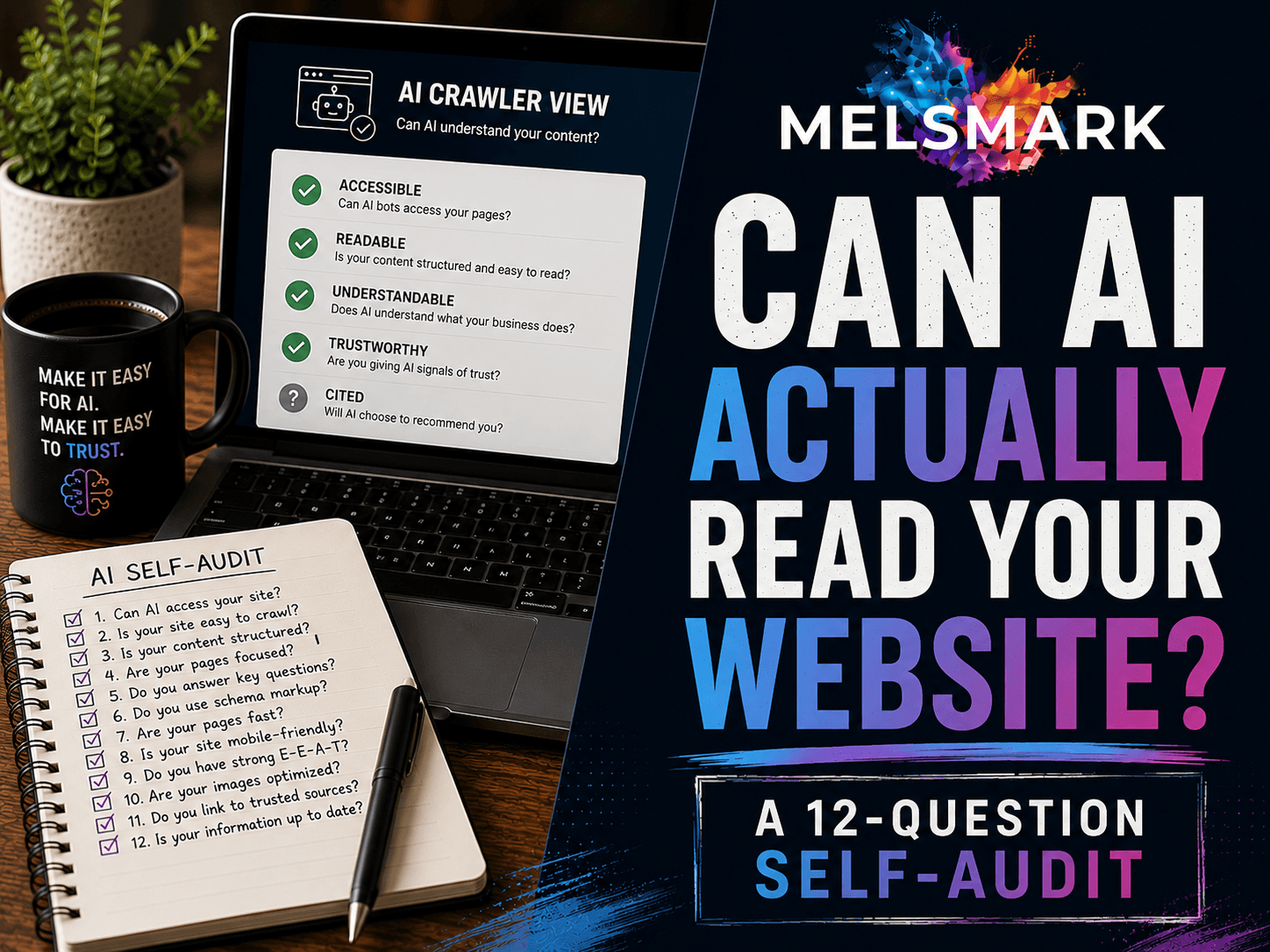
Twelve questions, about fifteen minutes, no software required. At the end you will have a score and a short list of what to fix first.
I built this because most small business owners are being told they have an AI problem without any way to check whether they do. If you want the reasoning behind these questions, my guide to how small businesses get found by AI covers the research underneath them. Some of you will score 10 or higher and can stop worrying. Some will find one broken thing that is quietly costing you everything. Better to know.
Answer each one yes or no. Give yourself a point for every yes.
Section One: Can AI Find You at All?
- Is your Google Business Profile claimed, verified, and completely filled in?
Every field. Hours, phone, website, description, categories, service area, photos.
Why it matters: Google's Gemini is grounded directly in Google Maps data. Your profile is not one signal among many for that platform. It is the source. SOCi's 2026 research found business profile accuracy of 100% on Gemini against roughly 68% on ChatGPT and Perplexity, which tells you how directly that data flows through.
How to fix: Search your business name on Google and follow the prompts to claim it, or start at google.com/business.
- Have you claimed your Bing Places listing?
Why it matters: ChatGPT Search launched using Bing's index as a primary data source. Bing Places is the verified, structured record of your business inside that index. Most local businesses have never touched it, which is exactly why it is worth the ten minutes.
How to fix: bingplaces.com. You can often import directly from your Google profile.
- Does your business appear on at least five reputable sites besides your own?
Directories, chamber membership, review platforms, a supplier's partner page, a local news mention. Count them.
Why it matters: An AI cannot verify anything you say about yourself. It builds confidence by checking whether independent sources agree with you. A business that exists only on its own domain has exactly one source vouching for it.
How to fix: Start with your local chamber of commerce, then the two or three directories that actually matter in your industry.
Section Two: Can AI Read What Is There?
- Does your robots.txt file allow AI crawlers?
Visit yoursite.com/robots.txt and look for any rule blocking GPTBot, OAI-SearchBot, ChatGPT-User, ClaudeBot, or PerplexityBot.
Why it matters: OAI-SearchBot is the crawler that builds the index behind ChatGPT's cited answers. Block it and you are removed from consideration entirely, no matter how good everything else is.
How to fix: Ask whoever manages your site to allow them explicitly. Also check whether you are behind Cloudflare, which since July 2025 has asked new sites whether to allow AI crawlers and blocks them by default. A lot of businesses are blocking these crawlers without ever having made that decision.
- Does your website content appear in the page source, not just after JavaScript runs?
Right-click your homepage, choose View Page Source, and use Ctrl+F to search for a sentence you can see on the page.
Why it matters: If the text is not in the source, some AI crawlers may see an empty page. The third-party consensus, not an official statement, is that OAI-SearchBot does not execute JavaScript.
How to fix: This is a build-level issue. If the text is missing, your site needs server-side rendering, which is a conversation with your developer.
- Does every important page have a clear, descriptive title and description?
Not "Home." Not "Services." Something that says what the page is and where you are.
Why it matters: These are often the first thing a system reads about a page, and they set the frame for everything else.
Section Three: Is There Anything Worth Quoting?
- Does your site answer the question "how much does this cost?" with an actual number or range?
Why it matters: Cost queries trigger AI Overviews more than 80% of the time, and most local businesses refuse to answer them. That refusal hands the citation to whoever did. You do not need a fixed price. A range with the variables explained is enough.
How to fix: One page. "Most [your service] projects in [your area] run $X to $Y. Here is what moves that number." That page will outperform almost anything else you write.
- Does your content contain specific numbers, dates, and named sources?
Not "many homeowners" but "roughly a third of homeowners, according to [source]."
Why it matters: This is the best-evidenced item on the entire list. The Princeton and Georgia Tech GEO study published at KDD 2024 tested nine content strategies across 10,000 queries. Adding statistics, citing sources, and adding quotations were among the top performers, producing up to about 40% improvement in AI visibility. Keyword stuffing made things worse.
- Do your pages answer the question in the first two sentences?
Before the background, before the introduction, before your company history.
Why it matters: Both a machine and a person in a hurry are looking for the same thing. Burying the answer under three paragraphs of throat-clearing helps neither.
- Do you have content that answers real customer questions, not just service descriptions?
Most local business websites are entirely "who we are" and "what we sell." Very few answer "how long does this take," "what should I expect," "what goes wrong," or "how do I know if I need this."
Why it matters: Informational local queries trigger AI Overviews around 92% of the time. If you have nothing informational, you are not in that conversation at all.
Section Four: Does Anyone Vouch for You?
- Have you received at least one genuine review in the last 90 days?
Why it matters: Recency is a signal now, not just volume. BrightLocal's 2026 survey found 74% of consumers look for reviews written in the last three months. Twenty excellent reviews from 2023 lose to eighty with a steady trickle from this quarter.
How to fix: Build the ask into the end of every job. A short message with a direct link. Not a campaign, a habit.
- Is your business name, address, and phone number identical everywhere it appears?
Your website, Google, Bing, Facebook, every directory. Same format, same suite number, same phone.
Why it matters: This is the least interesting item here and possibly the most decisive. Four versions of your phone number does not give a machine four sources. It gives it a reason to hesitate and recommend somebody else.
Scoring
Add up your yes answers.
10 to 12: Strong. You are in better shape than the large majority of small businesses. Focus on the content questions, 7 through 10, since that is where remaining gains usually are.
7 to 9: Gaps worth closing. Most businesses land here. Nothing is broken but several things are half-done. Work through your no answers in order, since the early ones matter more.
4 to 6: Real problems. There is probably at least one thing here actively preventing you from being found. Start with questions 4 and 5, because if those are no, nothing else you do will matter until they are fixed.
Under 4: Start at the top. Question 1 alone, done properly, will move you more than anything else on this list. It is free and takes an afternoon.
What to Do With Your Score
Fix them in order. The list is roughly sequenced by impact, and the early items are cheap.
If you scored low on 4 or 5, deal with those first regardless of everything else. Those are the ones where you can do a year of good work and get nothing for it because a crawler cannot get in the door.
If you scored well on the technical items but poorly on 7 through 10, you have the more common problem: a technically sound website with nothing on it worth quoting. That is a writing problem, not a development problem, and it is genuinely fixable without hiring anyone.
Send Me Your Score
I'm curious what people are actually finding, and I am happy to look at specific situations.
Send me your score and the questions you answered no to, and I will tell you honestly which one I would fix first and whether it is something you can handle yourself. No pitch attached. If the answer is "you can do all of this in a weekend without me," I will say so, because that is true more often than the marketing industry likes to admit.
Frequently Asked Questions
How often should I run this audit?
Twice a year is plenty for most small businesses, plus any time you change your website, move locations, or update your phone number. The technical items rarely change on their own. The review and content items are ongoing habits rather than one-time fixes.
Do I need any tools or paid software to do this?
No. Every question can be checked with a browser. Questions 4 and 5 require looking at your robots.txt file and your page source, both of which are free and public on every website including yours.
What if I do not understand questions 4 and 5?
Send them to whoever built or hosts your website and ask directly: does our robots.txt allow AI crawlers, and is our content server-rendered? Those are two questions any competent developer can answer in a minute. If they cannot, that tells you something too.
Is a high score a guarantee I will show up in AI answers?
No. AI recommendations are highly selective and nobody can guarantee placement. What a high score means is that you have removed the obstacles and given the systems what they need to be confident about you. The rest depends on competition in your market.
Want a second pair of eyes on your score?
I build websites for Minnesota small businesses from East Bethel, serving Forest Lake, Anoka County, and the Twin Cities metro. About ten years in technical support before that, so the under-the-hood questions above are the part I actually enjoy.
Send me your results, or work through the free Local SEO Checklist for the fuller version.