Small Business SEO
How to Get Your Business Recommended by ChatGPT
July 27, 2026
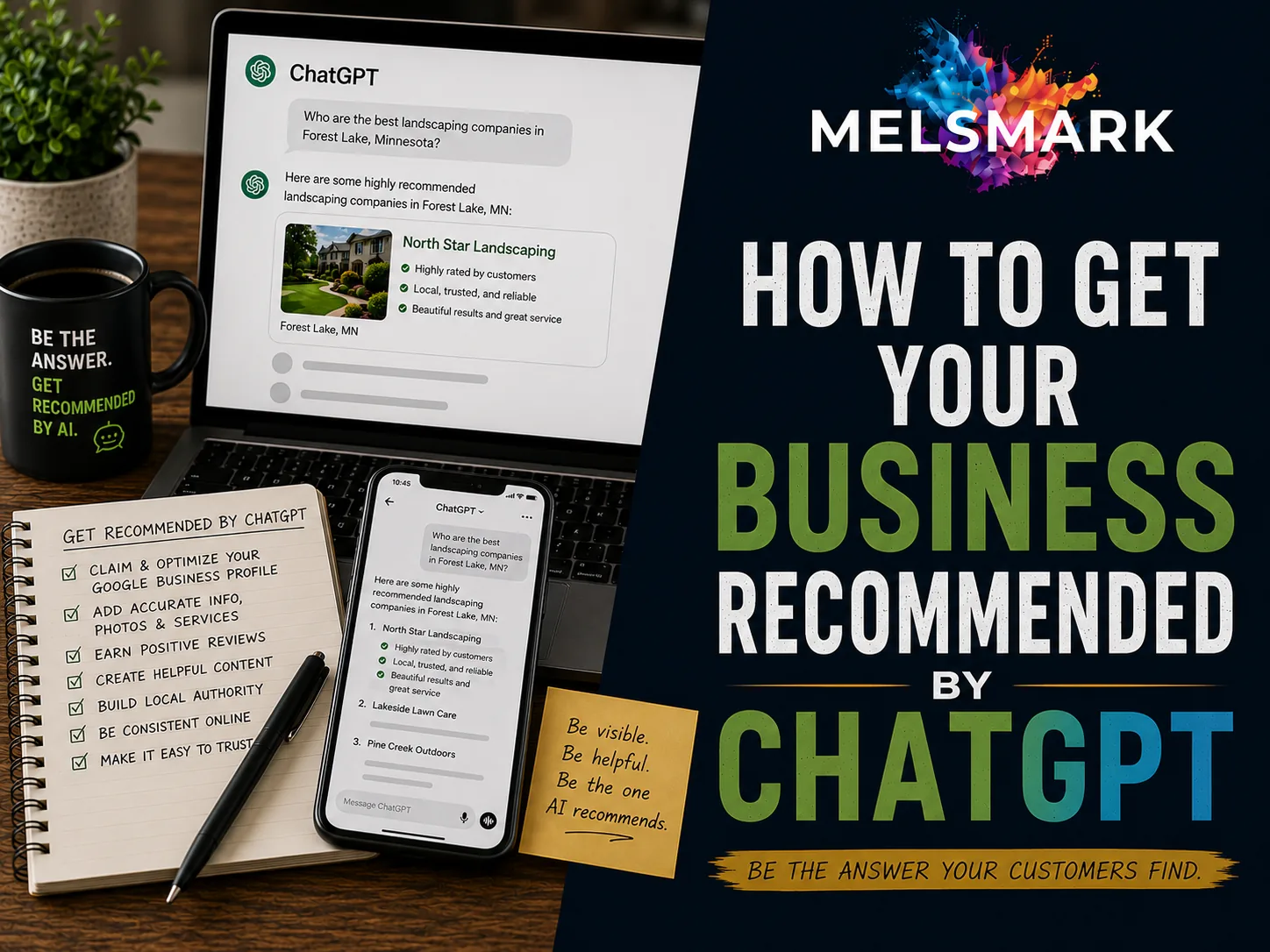
To get recommended by ChatGPT, you need three things: your business facts consistent everywhere they appear online, enough recent third-party proof that you exist and do good work, and a website ChatGPT's crawler can actually read. There is no submission form and no way to pay for placement. What you can do is make yourself the easiest business in your category to be confident about.
Thirty-one percent of consumers used ChatGPT specifically for a business recommendation in the past year, per BrightLocal's 2026 research. Among 30 to 44 year olds, 64% have asked an AI for a business recommendation. If you sell to homeowners, that is your buyer.
This post is specifically about ChatGPT. If you want the wider picture across Google's AI Overviews, Gemini, and Perplexity too, start with my guide to how small businesses get found by AI.
Here is what actually moves the needle, in order.
First, Understand Where ChatGPT Gets Its Answers
This matters because it explains why some of the advice below looks different from normal SEO.
OpenAI runs three separate crawlers, and they do different jobs. GPTBot collects content that may train future models. OAI-SearchBot builds the search index that powers ChatGPT's cited web answers. ChatGPT-User fetches a specific page live, when someone asks ChatGPT to look at something.
The one that determines whether you appear in ChatGPT's answers is OAI-SearchBot. Block it in your robots.txt file and you are removed from consideration, no matter how good your website is.
ChatGPT Search launched using Bing's index as a primary data source, through OpenAI's partnership with Microsoft, and supplements it with its own crawling. Botify's analysis of more than seven billion log files between November 2024 and March 2026 found OpenAI has roughly tripled its crawl of the web, with the search crawler growing fastest, which suggests it is building out its own index rather than leaning entirely on Bing.
The honest summary is that the exact mix is not public and it is changing. What is reliable: Bing indexing still helps, OAI-SearchBot access is required, and being readable matters more than being ranked.
Seven Things That Actually Help
- Claim and complete your Google Business Profile.
Counterintuitive for a ChatGPT post, but here is why it belongs first. Your Google Business Profile is the canonical source for your business facts across the whole web. Directories pull from it. Other sites cite it. And Google's own Gemini is grounded directly in Google Maps data, which is why SOCi's 2026 research found business profile accuracy of 100% on Gemini versus roughly 68% on ChatGPT and Perplexity.
Fix the source and the copies improve. My Google Business Profile guide covers the setup properly.
- Claim your Bing Places listing.
Almost nobody does this, which is exactly why it is worth ten minutes. Bing Places is Microsoft's equivalent of Google Business Profile, and given ChatGPT's Bing relationship, it puts a verified, structured record of your business in the index ChatGPT has historically drawn from. Most local businesses have never touched it.
- Make your business details identical everywhere.
Same business name. Same address format. Same phone number. Same hours. Your website, your Google profile, your Bing listing, Facebook, every directory you have ever been added to.
This is boring and it is the highest-value item on the list. An AI system has no way to independently verify that you exist. It builds confidence by checking whether independent sources agree. Four versions of your phone number does not give it four sources. It gives it a reason to hesitate and recommend somebody else.
- Get reviews, and keep getting them.
Volume, rating, and recency all count. BrightLocal's 2026 survey found 74% of consumers look for reviews written in the last three months, and 31% will skip a business rated under 4.5 stars. AI systems apply similar logic for a sensible reason: they cannot judge your work, so they use reviews as a proxy, and recent data is more likely to still be accurate.
Build the ask into the job. After good work, a short message with a direct link. Not a campaign, a habit. Responding matters too: BrightLocal found generic or templated replies put off 50% of consumers, who read them as a sign of indifferent service. More on why reviews and citations decide whether AI reccomends you
- Make sure your website is server-rendered.
If your site builds its content with JavaScript in the visitor's browser, some AI crawlers may see an empty page. The third-party consensus, not an official statement, is that OAI-SearchBot does not execute JavaScript.
There is a related trap worth knowing about: since July 2025, Cloudflare has asked new sites whether to allow AI crawlers and blocks them by default. If your site was set up on Cloudflare since then, or somebody switched that setting on, you may be invisible to ChatGPT without having made any real decision about it. Worth checking either way.
- Exist somewhere other than your own website.
A business that appears only on its own domain is a business with one source vouching for it, and that source is you. Directory listings, chamber of commerce membership, review platforms, a supplier's partner page, a local news mention. These are the corroboration an AI needs before it will say your name with any confidence.
- Answer the questions people actually ask, including the price one.
Cost queries are among the most common things people bring to an AI, and most local businesses refuse to answer them publicly. That refusal hands the citation to whoever did answer.
You do not need to publish a fixed rate. Publish a real range and explain what moves it. That is a factual, quotable answer, and it treats the person asking like an adult.
Five Prompts to Test Where You Stand Today
Run these right now. It takes ten minutes and it is the only reliable measurement currently available.
- Who is the best [your service] in [your town], Minnesota?
- I need a [your service] near [your town]. Who should I call?
- What should I expect to pay for [your service] in [your area]?
- Recommend a reliable [your service] in [your county] County, MN.
- [Your business name] reviews, and then Tell me about [your business name]
Write down whether you appear, who appears instead, and whether the details it gives about you are correct. That last one catches more problems than people expect.
Run the same five prompts across ChatGPT, Gemini, and Perplexity, because they behave differently and pull from different places. Then repeat monthly. A spreadsheet with five rows and a date column is a perfectly good AI visibility tracker.
What to Do When a Competitor Gets Named and You Do Not
Do not panic and do not go buy a GEO subscription. Go look at what the competitor has that you do not.
Nine times out of ten it is one of three things. They have substantially more recent reviews. They are listed in more places, so more independent sources confirm they exist. Or they have content answering the specific question that was asked, and you do not.
All three of those are fixable, and none of them require a vendor. The fourth possibility, worth ruling out early, is that your site is blocking the crawler or is unreadable, in which case nothing else you do will matter until it is fixed.
One Honest Caveat
Getting named by ChatGPT is not the finish line.
BrightLocal found that among consumers already using AI for local searches, only 18% felt ready to contact a business the AI recommended. The other 82% kept researching. They checked Google, read reviews themselves, and went to the website. Eighty-eight percent said they fact-check the reviews an AI cites.
So the AI recommendation gets you into the running. Your website still has to close it. If someone hears your name from ChatGPT, looks you up, and finds a site that does not reflect the quality of your work, you have lost the job at the last step. That has not changed, and I do not think it is going to.
The six signals AI uses to pick a local business covers what the other platforms weigh, and most of it is the same work.
Frequently Asked Questions
Can I pay to be recommended by ChatGPT?
Not the recommendation itself. You can buy ads: OpenAI began showing ads to users on ChatGPT's Free and Go tiers in early 2026, and opened a self-serve Ads Manager in July 2026. Those are labelled sponsored placements that sit below the answer, and OpenAI states they do not influence its responses. There is still no way to buy the organic recommendation or citation, and no submission form. What you can influence is how confident the system is about your business, which comes down to consistency, corroboration, and readable content.
Does ChatGPT use Google or Bing?
ChatGPT Search launched with Bing as a primary data source through OpenAI's Microsoft partnership, and supplements it with OpenAI's own crawler, OAI-SearchBot. Evidence from crawl-log analysis suggests OpenAI has been building out its own index substantially. The precise blend is not publicly documented and appears to be shifting, so the practical answer is to be indexed and readable everywhere rather than optimizing for one.
How do I know if my site is blocking AI crawlers?
Visit yoursite.com/robots.txt and look for any rule disallowing GPTBot, OAI-SearchBot, ChatGPT-User, ClaudeBot, or PerplexityBot. Also check whether your site sits behind Cloudflare, which has blocked AI crawlers by default for sites added since July 2025. If you are unsure, ask whoever built or hosts your site.
How long before ChatGPT knows about my business?
There is no published figure and estimates vary widely. Profile and review changes tend to register faster than content changes. The practical approach is to make the fixes, then run your five test prompts monthly and watch for movement rather than waiting on a promised timeline.
Want to know whether AI can even see your website?
I build websites for Minnesota small businesses in Forest Lake, East Bethel, and across Anoka County, and I make sure they are readable by the systems people now ask for recommendations.
Run the five prompts above, send me what you find, and I'll tell you honestly what I'd fix first. Get in touch.