
Blog · Small Business SEO
How Roofers Show Up in Search When a Storm Hits
By Mel Neuberger ·
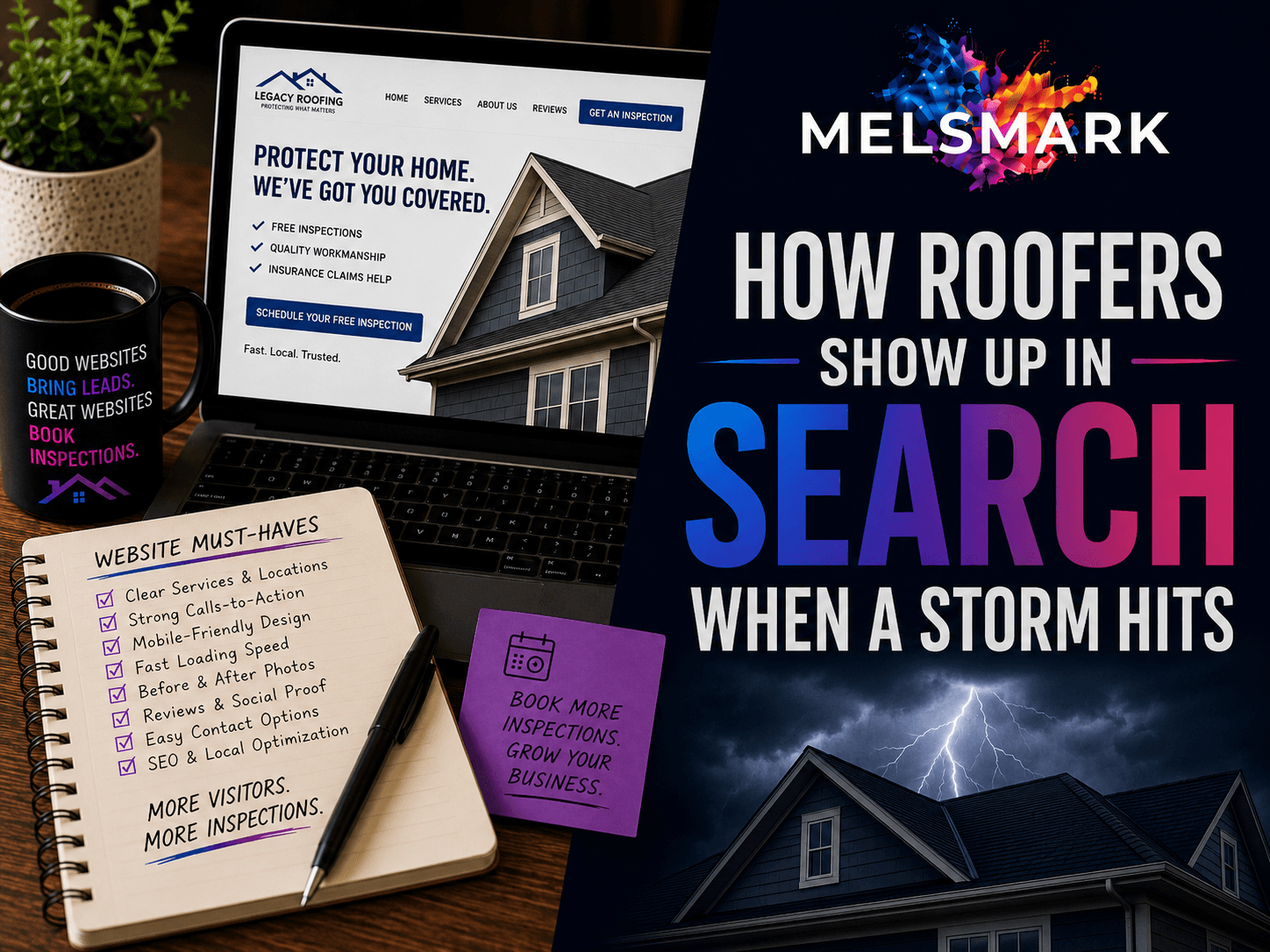
There is a pattern in roofing that anyone who has worked a storm season knows. Hail comes through on a Tuesday afternoon. By Tuesday evening, searches for roof repair in that zip code jump by a factor most industries never see. By Thursday, out-of-state crews are knocking doors.
And the roofers who capture that traffic are almost never the ones who started working on it Wednesday morning.
Search visibility has a lag. Whatever you rank for during a storm week was decided by work done weeks or months earlier. That is the uncomfortable part, and also the useful part, because it means the work is schedulable. You can do it in February.
What Actually Changes During a Storm Spike
Three things happen at once when a storm goes through a market:
Search volume jumps. Not gradually. Terms like emergency roof repair and hail damage inspection can go from nearly nothing to the busiest they will be all year, in a single evening.
The searches get more specific and more local. People search their own town. They search their neighbourhood. They search with urgency words attached: emergency, today, now, near me.
Competition arrives from outside. Storm chasing crews run paid ads targeted to the affected zips within a day. You will not out-spend them. You can out-rank them organically, because they have no local footprint and Google's local results care about that a great deal.
That last point is the whole opportunity. The advantage you have over an out-of-state crew is precisely the thing that takes months to build and cannot be bought in a week.
The Foundation: Your Google Business Profile
For local roofing searches, your Google Business Profile does more work than your website. It is what feeds the map pack, and the map pack is what a panicked homeowner taps first.
The things that matter most:
- Categories set correctly. Roofing contractor as primary, with relevant secondaries. This sounds trivial and it is one of the strongest ranking signals in local search.
- Service areas defined honestly. List the towns you genuinely cover.
- Photos added regularly. Job photos, crew photos, trucks. Profiles with recent activity outperform dormant ones.
- Reviews arriving steadily. Not thirty at once in March and nothing after. A steady trickle reads as a real business and weathers algorithm changes better.
We have written more on this in our guide to Google Business Profile for Minnesota small businesses.
Service Area Pages, Done Properly
This is where roofing companies either build a real advantage or create a problem for themselves.
Done well, a service area page is a genuine page about roofing in a specific town: what the housing stock is like, what storms have come through, what you have worked on there, how far it is from your shop. That page can rank for that town and it earns the ranking.
Done badly, it is the same four paragraphs repeated twenty times with the town name swapped. Search engines are extremely good at recognising that pattern now, and the pages either fail to rank or drag on the rest of the site.
The honest rule: build a service area page for a town when you have something true and specific to say about working there. Five good ones beat twenty thin ones, and they will not put your site at risk.
Content That Ages Well
Storm-season content should be written in the off season, because it needs time to be indexed and to accumulate signals before it is needed.
Topics that keep earning:
- What hail damage actually looks like on different roofing materials
- How a roofing insurance claim works, start to finish
- How to tell whether you need repair or full replacement
- What to check after a windstorm, before calling anyone
Notice these are not sales pages. They answer questions homeowners have during exactly the moment your services become relevant, which is what makes them useful when the spike arrives.
The claims process piece is often the highest performer. It is genuinely confusing, most homeowners have never done it, and most roofing sites do not explain it.
Reviews Are a Ranking Factor and a Closing Tool
In a storm week, a homeowner comparing three roofers will read reviews before calling any of them. Review count, recency, and rating all feed local rankings, and they do the closing work before you speak to anyone.
The practical version: ask every completed job, the same week the job finishes, in writing, with a direct link. Most contractors ask inconsistently and are surprised by the results when they ask consistently.
The Off-Season Checklist
If storm season is months away, this is what to work through:
- Google Business Profile: categories, service areas, hours, current photos
- A review request that goes out after every completed job, automatically
- Three to five genuine service area pages for the towns that matter most
- An insurance claims explainer written for homeowners
- Site speed checked on an actual phone, not a desktop
- Hosting that can survive a traffic spike
None of it is dramatic. All of it compounds, and all of it has to be in place before it can help.
Frequently Asked Questions
How long does local SEO take to work for a roofing company?
Expect three to six months before meaningful movement, longer in competitive metro markets. That is precisely why storm-season visibility has to be built in the off season. Anything started the week of a storm will arrive too late to help with that storm.
Is it worth running paid ads during a storm instead?
Paid ads work during spikes, and they are the one channel that responds immediately. The catch is that storm chasers bid aggressively on exactly those terms in exactly those weeks, so costs spike with the traffic. Most local roofers do best treating ads as a supplement to organic visibility rather than a replacement for it.
Should I create a page for every storm event?
Generally no. Event-specific pages date quickly and rarely rank in time to matter. A well-maintained hail damage page and a claims process page will serve you across every storm, year after year.
Do I need a blog if I am a roofing contractor?
You need content that answers homeowner questions, whether or not you call it a blog. Four genuinely useful articles that stay accurate will outperform monthly posts written to hit a schedule. For more on the fundamentals, see our local SEO guide for Minnesota small businesses.
Melsmark builds roofing websites with local SEO included from day one. See our roofing company web design page, or get a free quote.